

Drone Innovation Transforms Coverage of the 2026 Milan Cortina Olympics
Breathtaking drone footage has emerged as one of the stars of the 2026 Milan Cortina Winter Olympics, immersing audiences in the sights, sounds, and high-flying action of the Winter Games like never before.
February 17, 2026
Drone coverage of the Olympics goes back to Sochi in 2014, but the technology, image quality, and even piloting skill have grown tremendously in the past decade. In 2026, flying cameras have become faster and more agile, with lower latency, greater throughput, and higher resolution, enabling them to transmit broadcast-quality live video of the Winter Olympics for the first time. The ability to follow athletes at competition speeds in luge and skeleton, alpine and freestyle skiing, speed skating, snowboarding and more has transformed how viewers back home experience the games. Professional athletes and broadcasters have also taken note of the new technology, with NBC Sports' Mike Tirico among those highlighting its impact.
The Olympic Broadcasting Services (OBS) operates the drones, providing live footage to broadcasters including NBC Sports. As in so many other aspects of the long-standing partnership, NBCUniversal's commitment to bring greater immersion to its viewers aligns with the International Olympic Committee's mantra this year: "Movement in Sport."
"Technology increasingly offers us a lot of opportunities," says Yiannis Exarchos, CEO of OBS. "But the Olympic Games are not about showcasing technology. They are about finding the most engaging ways of telling the stories of the biggest athletes in the world in the most efficient way possible."
OBS operates 25 drones across outdoor and select indoor venues in Milan and the Dolomites. Fifteen are first-person-view (FPV) drones. Making their Winter Olympics debut, FPV drones enable the pilot to fly by looking through one video camera while a director and technician capture footage through a second broadcast-quality camera.
Meet the new drone pilots
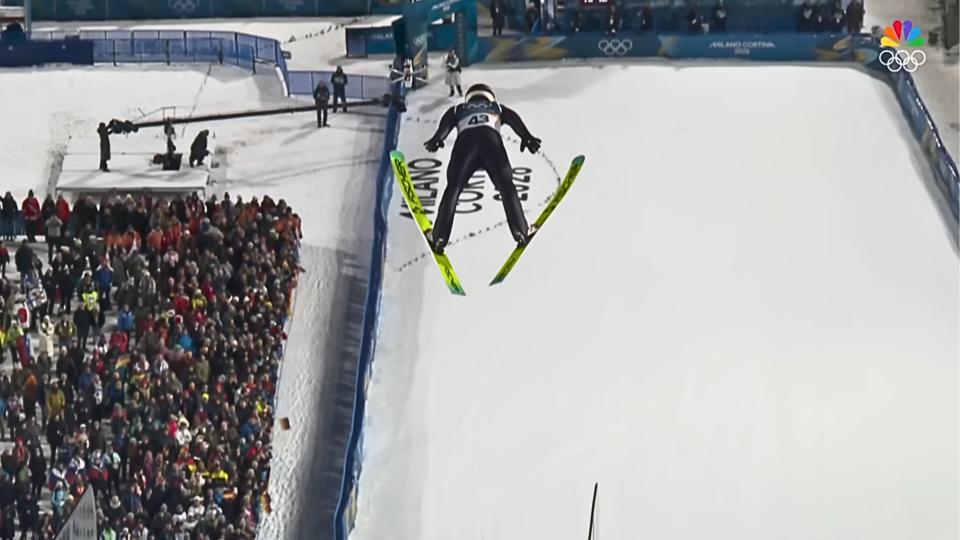
Technology is not all that is making strides over prior Olympics. Also making an evolutionary step at Milan Cortina are drone operators who have spent the intervening years honing skills and techniques that were still in their infancy in previous editions. Drone crews, comprising a pilot, technician, director, and pit crews on hand for rapid battery changes, are trained extensively in the sports they are covering. Some pilots are even former competitors themselves, like Jonas Sandell, a former Norwegian national team jumper who covers ski jumping at Milan Cortina.
"Every athlete accelerates and flies differently," Sandell explains, speaking to the broadcast technology publication NCS. "If you don't understand those subtleties, you miss the moment or outrun them. Seeing an athlete soar 140 meters through the air on two skis is incredible. I want audiences to experience that sensation as if they were in the air too."
In addition to extensive training, pilots must also adhere to strict IOC rules ensuring safety of the athletes and spectators, without distracting competitors or interfering in competitions. For example, drones are never permitted to fly in front of athletes during an event.
Now chipping in: AI technology's debut at Milan Cortina
Viewers at home watching this year's enhanced on-screen analysis and breakdown are benefitting from new AI-driven video capabilities, another tech advancement over previous Games. Next-generation Matrix-like 360° replay systems enable instant real-time conversion of video, creating slow motion wrap-around footage capable of analyzing a crucial moment in competition from any angle. AI-generated stroboscopic analysis breaks down high-speed moves into individual frames while on-screen graphics instantly track downhill lines for alpine skiers, luge and bobsled. In figure skating, on-air graphics measure jump height, airtime, speed, and other instant-delivery performance data. In many ways, viewers watching the NBC Sports broadcast or live feeds on Peacock garner more detailed insight – not to mention a more intense view of the action – than spectators on the ground.
Spectacular alpine vistas nearly steal the show
As exciting as the Winter Olympics are, the breathtaking backdrops of Cortina d'Ampezzo and the Italian Dolomites lend their own grandeur to the proceedings. FPV drone footage brings those views to life, soaring for example through the iconic Tofana Schuss, a steep chute between sheer rock walls at the top of the women's super-G and other downhill events.
With each Olympics, athletes strive to surpass all that has gone before, and NBCUniversal fully embraces that spirit. Partnering with Olympic Broadcasting Services to leverage drone footage and AI analysis is just one of many ways NBC Sports and Peacock are bringing unprecedented levels of innovation and immersion to the Milan Cortina Winter Olympics.