
20 Super Bowls in 60 Years: A Look Back as NBC Turns 100
For over half a century, NBCUniversal's platforms have amplified America's biggest game into one of the world's biggest annual television events. Ahead of Super Bowl LX, here's a look back at the 20 previous Super Bowls that have aired on NBC.
February 04, 2026
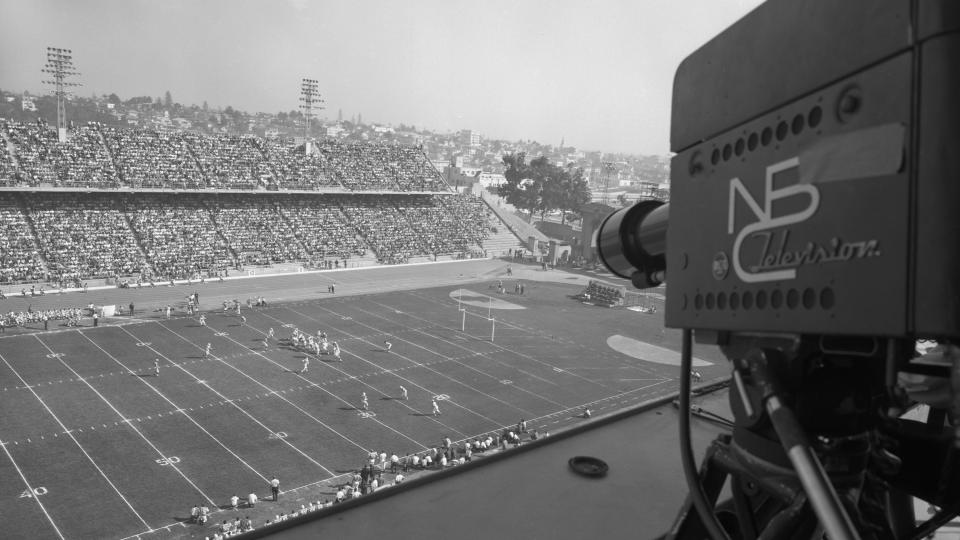
Pictured: an early AFL broadcast of the San Diego Chargers vs. Boston Patriots game at Balboa Stadium in San Diego, CA on October 31, 1965 (Photo by: NBC/NBCU Photo Bank).
Beginning with the very first Super Bowl in 1967, NBC Sports has been a key player in transforming football's greatest championship into one of the most-watched live events in sports. Over its run of 20 Super Bowls and counting, NBC has delivered unforgettable moments and historic upsets, amplifying the game through broadcast innovations and its acclaimed live event storytelling.
Last time it presented the game, NBC Sports made media history with the first-ever "Super Gold Sunday," airing both Super Bowl LVI and the 2022 Beijing Winter Olympics on NBC and Peacock.
This year the network will air an unprecedented three marquee events in a three-week stretch: the 2026 Milan Cortina Winter Olympics, Super Bowl LX, and the NBA All-Star weekend, all within 17 days. Called "Legendary February," this unprecedented trio of live blockbuster events will give fans unparalleled access to the games, the athletes, highlights, analysis, and more.
By bringing together resources, platforms and emerging technologies, NBCUniversal is creating new ways for fans to experience the biggest moments in sports. That momentum has been matched by advertisers, leading to record early sell-outs of ad inventory for both the Super Bowl and the Olympics.
This year, as part of the 100th anniversary of NBC, NBCUniversal looks back at an incredible Super Bowl history while looking forward to a year of celebrating NBC.
NBC Sports football history
Today, as NBC Sports laces up for its 21st Super Bowl as part of an unprecedented Legendary February, here's a look at key moments from the game's storied past.
In 1939, NBC set a broadcast milestone by airing the first-ever televised professional football game. The network brought the matchup between the Philadelphia Eagles and the Brooklyn Dodgers to about 1,000 televisions in New York City in what was to be the first of many firsts in the long-running broadcast partnership between NBC and the NFL.
In 1964, NBC Sports signed a five-year, $36 million contract with the American Football League (AFL) to broadcast the league's games for five years beginning in 1965. It was that partnership that would lead to NBC Sports' role in the first of many Super Bowls.
The first four Super Bowls and the NFL-AFL era
The Super Bowl was created as part of the 1966 merger deal between the National Football League (NFL) and its upstart rival, the American Football League; however, the actual merger would not take place until 1970. As a result, the first four Super Bowls pitted the two pre-merger rival leagues against one another.
Super Bowl I (1967): the game that changed football history
The inaugural Super Bowl was also the only one to be broadcast simultaneously by two major networks. NBC and CBS, who jointly purchased the broadcast rights for four years for $9.5 million in 1966, each carried the game on their networks, reaching a combined 51.2 million viewers. It was also the only Super Bowl in history not to sell out its stadium tickets. Every Super Bowl since has played before a sold-out stadium. Officially called the AFL-NFL World Championship Game at the time, the game would only retroactively be called Super Bowl I. As part of the league merger, NBC held the AFL broadcasting rights, while CBS carried NFL games. In that historic game, the NFL champion Green Bay Packers, led by legendary head coach Vince Lombardi, defeated Hank Stram's AFL champion Kansas City Chiefs 35-10, and the Super Bowl broadcast was on its way to becoming one of the world's most-watched sporting events.
Super Bowl III (1969): Joe Namath guarantees a win
NBC's second Super Bowl – the name now officially trademarked – became one of football's most celebrated upsets. The NFL's Baltimore Colts were heavy 18-point favorites to defeat the AFL champion New York Jets. The Jets went on to defeat the Colts 16-7 and Joe Namath's famous "guarantee" became Super Bowl lore.
NBC's coverage captured the drama and swagger that defined the era reaching 20.5 million households and 41.7 million viewers.
The Conference Era: NBC broadcasts games of the newly-named AFC
In 1970, the newly-merged NFL announced four-year television contracts under which CBS would televise all National Football Conference (NFC) games and NBC all American Football Conference (AFC) games (except Monday night games) and the two would alternate televising the Super Bowl and AFC-NFC Pro Bowl games. NBC's broadcast of Super Bowl V (1971) reached the largest household audience ever at the time for a single live sports event, with 46 million people tuning in as the Baltimore Colts defeated the Dallas Cowboys.
NBC was next on hand to chronicle the Miami Dolphins' perfect season, culminating in a 14-7 victory over Washington in Super Bowl VII (1973). In a broadcast milestone, this was the first Super Bowl to air live in its host city, marking the beginning of more relaxed NFL blackout rules for the Super Bowl. NBC's flagship KNBC Channel 4 carried the game to greater Los Angeles.
NBC then broadcast the Pittsburgh Steelers' defeat of the Minnesota Vikings in Super Bowl IX (1975). The Steelers' first Super Bowl victory was far from their last.
NBC's sixth Super Bowl, Super Bowl XI, took place at the Rose Bowl and featured a 32-14 Oakland Raiders victory over the Minnesota Vikings. The win was capped off with Willie Brown's unforgettable 75-yard interception return touchdown, and it would be John Madden's only Super Bowl win as head coach. Thirty-two years later the coaching legend would return to NBC in the booth as a sportscaster, calling Super Bowl XLIII (2009).
The Super Bowl in the 1980s: an age of innovation on NBC
Over the period stretching from Super Bowl XIII (1979) to Super Bowl XXXII (1998), NBC covered nine Super Bowls and developed a number of live broadcast innovations and formats that helped drive a period of epic growth for the sport.
"The Announcerless Game"
For the first time in television history, NBC Sports presented a game with no play-by-play or color commentary, known as “The Announcerless Game.” The season finale between the Jets and Dolphins was broadcast with no play-by-play from the booth, only sounds of the stadium and on-air graphics, with a brief pre-game introduction from Bryant Gumbel. Sensitive field microphones contributed to the sensation of "being there" for fans at home.
NBC also innovated new on-air graphics during this period, including the new "Quantel Cypher," first introduced during the 1988 Seoul Olympics broadcast. In another first of the era, NBC introduced football's first female announcer, with the pioneering Gayle Sierens calling play-by-play.
Super Bowl XX (1986) – the Super Bowl Shuffle
When a legendary Chicago Bears team defeated the New England Patriots 46-10 at Super Bowl XX in New Orleans, NBC's broadcast reached more than 127 million viewers, toppling the final episode of M*A*S*H as the most-viewed television program in history at the time.
By the mid-1980s, moments like the Billboard-charting and Grammy-nominated "Super Bowl Shuffle" reflected the event's growing cultural footprint and increasing expectations for what a Super Bowl broadcast can do.
The Silent Minute
Super Bowl XX featured yet another memorable innovation. During pre-game coverage, NBC aired "The Silent Minute," sixty seconds of dramatic countdown featuring nothing but a black screen and a clock. Near the end of the countdown, the numbers switched to roman numerals counting down from XX to I. "The Silent Minute," which was the highest-rated minute of pre-game coverage that year, was a concept devised to give viewers a quick break from the excitement of the day, an entertaining part of Bob Costas' first stint hosting a Super Bowl pregame show.
Back-to-Back Super Bowls (1993-1994)
In 1993 and 1994, NBC became the only network in history to solo broadcast back-to-back Super Bowls. In '93, NBC aired the Dallas Cowboys' 52-17 win over the Buffalo Bills to clinch Super Bowl XXVII. The following year was a Super Bowl déjà vu as NBC broadcast XXVIII, breaking the rotation for the first and only time in Super Bowl history, and the Cowboys once again beat the Bills 30-13.
"The Golden Year of Sports" (1996) – NBC becomes first to broadcast the World Series, Super Bowl, NBA Finals, and the Olympics in one year
Within a span of 10 months, the network broadcast the World Series (October 21-28, 1995), Super Bowl XXX (January 28, 1996), the NBA Finals (June 5-16, 1996), and the 1996 Atlanta Olympics (July 19-August 4) – the first time any broadcaster presented all four of these major events in less than a year's time.
Super Bowl XXX saw the Cowboys win their fifth Super Bowl title, defeating the Steelers 27-17 in an NBC broadcast that became the most-watched sporting event ever at the time averaging more than 94 million viewers.
2009-2022 – NBC returns to the Super Bowl and begins the era of modern football
NBC televised Super Bowl XLIII (2009) as the Pittsburgh Steelers defeated the Arizona Cardinals 27-23 to become the first team to win six Super Bowls. It was also the final game in John Madden's historic broadcasting career, and the Super Bowl XLIII moment remembered over all others is Santonio Holmes' game-winning tiptoe catch.
NBC became the first network to live stream a Super Bowl with Super Bowl XLVI in 2012. As Eli Manning completed a 38-yard over-the-shoulder pass to Mario Manningham to begin a nine-play, 88-yard scoring drive to give the Giants their second Super Bowl victory over the Patriots in four years, fans at home could stream the Super Bowl XLVI action on NBCSports.com and NFL.com.
The first-ever live stream of a Super Bowl attracted more than 2.1 million users, making it at the time the most-watched single-game event ever online and on tablets, according to data provided by Omniture and mDialog. The stream delivered HD-quality video, DVR controls and multiple camera angles along with social interactivity, including a live chat with Mike Florio from NBC's ProFootballTalk, plus tweets from Michele Tafoya, NBC Sports' sideline reporter, and Jimmy Fallon, the host of NBC's Late Night with Jimmy Fallon.
Viewers were also able to watch replays of popular Super Bowl TV commercials. The NBC Sports broadcast coverage of Super Bowl XLVI was the most-watched television program in U.S. history (111.3 million viewers) and the highest-rated Super Bowl in 26 years (47.1 household rating).
Innovations on the sidelines also propelled Super Bowl coverage of the era. NBC utilized dual SkyCams for Super Bowl LII (2018), offering an almost video game-like view of the action for viewers back home. Also debuting was new 3D imaging technology to help visualize players on the field.
Peacock enters the game in 2022 at Super Bowl LVI
NBC Sports' most recent Super Bowl kept alive the tradition of surpassing fan expectations each year, as Super Bowl LVI debuted NBC's new virtual graphics package, three new camera angles from the goal line, sideline, and end zone, and also employed the Trolley Cam which traverses the stadium at speeds up to 65 mph, plus Sony Venice cams on Steadicam rigs, all designed to immerse viewers more than ever in the excitement of the biggest night in football.
Peacock also got into the action, streaming its first-ever Super Bowl and making Super Bowl LVI the most-streamed Super Bowl ever at the time with an unprecedented 11.2 million viewers.1
Beginning in 1967 and spanning 20 Super Bowls – soon to be 21 – NBC Sports has been a consistent broadcast home for America's biggest game. Over the decades, the network has contributed to the evolution of the Super Bowl from a championship matchup into a nationwide cultural moment. From pre-game coverage to post-game highlights, NBC Sports continues to help shape how fans experience the event each year.
21 Super Bowls broadcast by NBC
- Super Bowl I (1967)
- Super Bowl III (1969)
- Super Bowl V (1971)
- Super Bowl VII (1973)
- Super Bowl IX (1975)
- Super Bowl XI (1977)
- Super Bowl XIII (1979)
- Super Bowl XV (1981)
- Super Bowl XVII (1983)
- Super Bowl XX (1986)
- Super Bowl XXIII (1989)
- Super Bowl XXVII (1993)
- Super Bowl XXVIII (1994)
- Super Bowl XXX (1996)
- Super Bowl XXXII (1998)
- Super Bowl XLIII (2009)
- Super Bowl XLVI (2012)
- Super Bowl XLIX (2015)
- Super Bowl LII (2018)
- Super Bowl LVI (2022)
- Super Bowl LX (2026)
NBCUniversal's Live Broadcasts for 2026
Super Bowl LX and "Legendary February" represent a key part of NBCUniversal's overall dominance in live entertainment in 2026. This will be an unprecedented year as NBCUniversal will host 40% of the industry’s major live broadcasts in 2026, delivering the biggest moments in media. In addition to the Olympic Winter Games and Super Bowl LX, highlights of the year include: the 100th Macy's Thanksgiving Day Parade , the FIFA World Cup on Telemundo, NBA and WNBA, Sunday Night Football, Sunday Night Basketball, Sunday Night Baseball, BIG10, the Ryder Cup, the U.S. Open, the Emmys, Major League Baseball games, the Kentucky Derby, and more. For viewers tuning in for live action as it happens, 2026 will be a hard year to beat.
1 Led by Peacock, the Average Minute Audience (AMA) for the Super Bowl live stream via Peacock, NBC Sports Digital platforms, NFL Digital platforms, Rams and Bengals mobile properties, and Yahoo Sports mobile properties, plus co-viewing from connected devices added up to an unprecedented 11.2 million AMA viewers.